Mud, Cobbles and Glory: Roubaix Revisited
From Deignan in the mud to Koch beating a Visma two-against-one: how six editions made Roubaix a symbol, and why the stones still expose every plan.
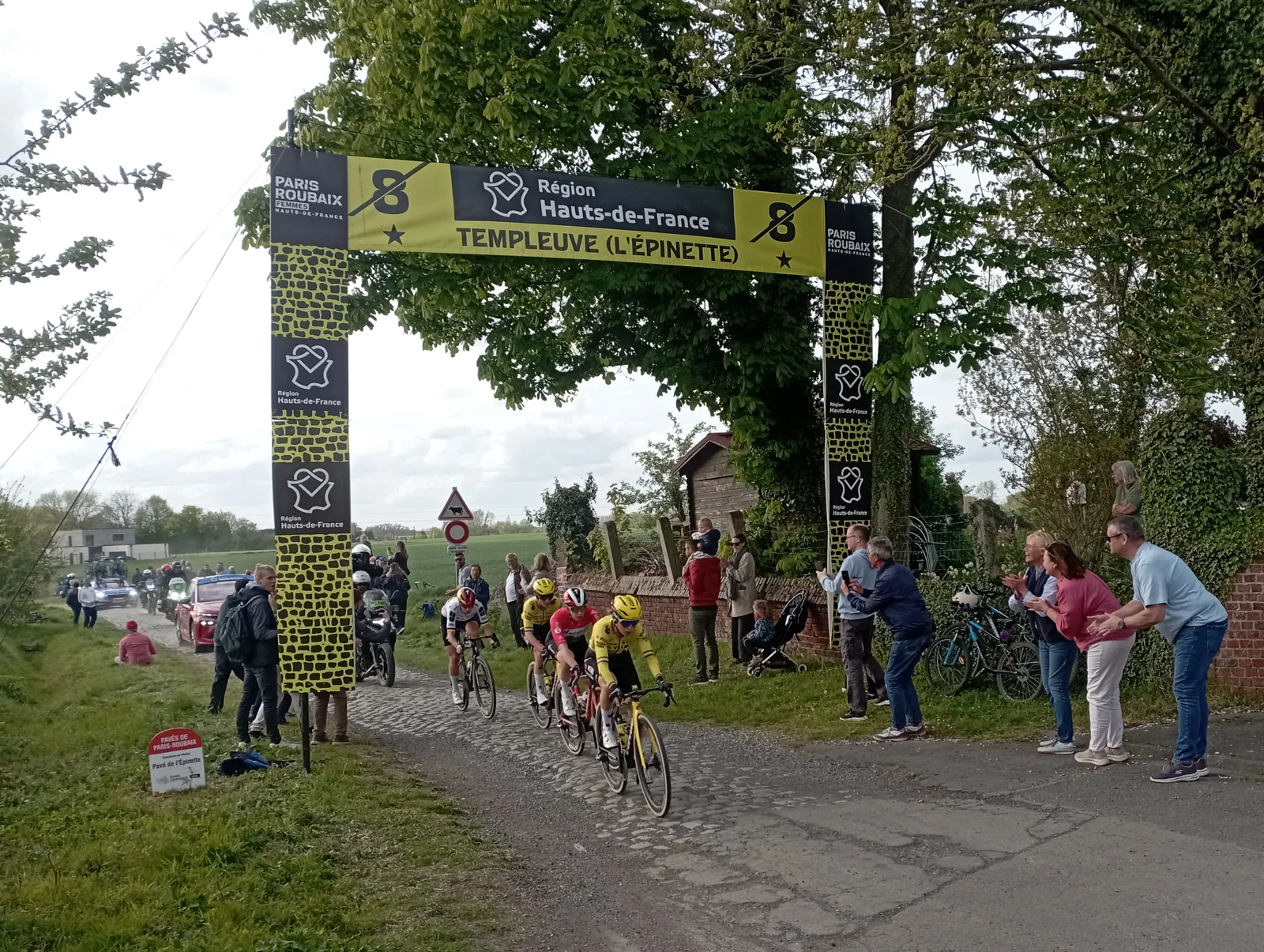
The most revealing moment came after the cobbles. Pauline Ferrand-Prévot, the defending champion, entered the Roubaix velodrome with Marianne Vos and Franziska Koch. Visma–Lease a Bike had two riders against one. Ferrand-Prévot committed first, sacrificing the chance to repeat so Vos could begin the sprint from Koch's wheel. Koch went high on the banking, plunged down, was passed, and came back. At the line, the supposedly outnumbered rider had beaten one of cycling's greatest finishers.
A road race designed to break plans
Paris–Roubaix is almost flat. The 2026 route from Denain climbed only 581 m (1,906 ft), modest beside any Ardennes Classic. Its difficulty was arranged horizontally: twenty sectors of pavé, each one narrowing the useful road, shaking bottles loose, punishing a poorly chosen line and turning a puncture into a tactical emergency. Mons-en-Pévèle and Carrefour de l'Arbre carried the maximum five-star rating. The new Haveluy-to-Wallers sector added another four-star test.
The skills are contradictory. A rider must be relaxed enough to let the bicycle move beneath her, forceful enough to keep speed over broken stones, and alert enough to fight for the crown of the road without touching the wheel beside her. Teams put helpers in front before every sector, distribute spare wheels along the course and try to preserve leaders. Roubaix keeps making those plans obsolete.
The race begins before the favourites
Rosa Klöser attacked after roughly 9 km (5.6 mi), an early move with a practical purpose. A rider ahead of the bunch avoids its crashes and forces the powerful teams to spend energy. Behind, Alison Jackson punctured and returned. Klöser's advantage survived into the cobbled sequence before the favourites' teams finally absorbed her.
The day was dry and warm, but dry Roubaix is not gentle Roubaix. Dust hides holes and coats eyes; speed rises; crashes arrive with less warning. Near Orchies, a heavy fall ended Chloé Dygert's race. The shoulder damage she sustained eventually required surgery. It was the other arithmetic of the Hell of the North: every rider still upright is spending luck as well as energy.
Dygert's injury and recovery: Cyclingnews — August 2026 recovery update ↗
Ferrand-Prévot lights the fuse
After Mons-en-Pévèle, Ferrand-Prévot accelerated on a small rise. The move was not a speculative drift. It was the defending winner imposing a selection while Visma still had Vos protected behind it. Only Blanka Vas, Vos and Koch could follow. Four riders became the race, and the teams behind were forced into an ugly choice: chase a dangerous move while helping the favourites already trapped inside it.
SD Worx–Protime had Vas in front but Lotte Kopecky and Lorena Wiebes behind. Chasing would erase their own rider's chance; waiting risked letting Visma's two leaders control the final. Lidl–Trek and UAE Team ADQ took up much of the pursuit, but the gap grew beyond a minute. The numerical advantage had moved up the road.
Koch was the anomaly in the quartet: one FDJ United–SUEZ jersey between two Visma leaders and an SD Worx rider. Yet isolation simplified her race. She did not have to protect a sprinter behind or negotiate leadership. When she accelerated on the Bourghelles–Wannehain stones, Vos followed and Vas lost contact. Ferrand-Prévot made it three again.
Two against one — and the one wins
Visma used its advantage honestly. Ferrand-Prévot drove the trio toward Roubaix for Vos, who was racing after the recent death of her father, Henk. Koch refused to panic or waste a move. The trio reached the velodrome together; Ferrand-Prévot led out, Vos came around, and Koch found a second acceleration before the line. Ferrand-Prévot crossed six seconds later. Kopecky won the chase for fourth at 1:30; Megan Jastrab was fifth on the same time.
For Koch, it was a first Women's WorldTour victory. That matters to the meaning of Roubaix. The race can reward the most decorated rider in the world, but it can also give a domestique one perfectly clear day on which nobody else's palmarès counts.
Race report, decisive move and finish: Paris–Roubaix Femmes — official 2026 report ↗
Pauline, one year earlier
Ferrand-Prévot had arrived in 2025 only months into her return to road racing. She was recovering from illness, crashed before Mons-en-Pévèle and had to chase. Then, in the final 20 km (12.4 mi), she attacked, bridged to Emma Norsgaard and left her behind on the Camphin-en-Pévèle sector. She entered the velodrome alone, 58 seconds ahead of Letizia Borghesi, the first Frenchwoman to win the race.
The win carried several careers at once: the former road, cyclocross, mountain-bike and gravel world champion; the Olympic mountain-bike champion returning to the road; the French rider winning on French stones. A year later, wearing number one, she made the move that decided the race and then surrendered her own finish to Vos. Roubaix revealed a different kind of authority: not defending a title at all costs, but knowing exactly when it belonged to a teammate.
Ferrand-Prévot's solo victory: Paris–Roubaix Femmes — official 2025 report ↗
The first race made the argument obsolete
The women's race began in October 2021, after 125 years of the men's event. Rain had turned the stones brown and slick. Lizzie Deignan attacked before the first cobbled sector, not as Trek–Segafredo's designated leader but as a rider anticipating trouble, and rode roughly 80 km (49.7 mi) alone. Her bloodied hands became the image of the inaugural edition. The question of whether women could race Roubaix was answered by the scale of the racing itself.
The editions that followed refused a single formula. Elisa Longo Borghini won alone in the dust in 2022. In 2023, Alison Jackson helped an early break survive and then won its velodrome sprint, an upset built from cooperation and nerve. Lotte Kopecky brought the rainbow jersey to the front in 2024 and won from six. Ferrand-Prévot's 2025 solo restored the long-range attack. Koch's 2026 sprint overturned a two-against-one finale.
Deignan's inaugural 80 km (49.7 mi) solo: Cycling Weekly — 2021 race report ↗
Kopecky in rainbow bands: Paris–Roubaix Femmes — official 2024 report ↗
Jackson's breakaway upset: Paris–Roubaix Femmes — official 2023 report ↗
A symbol is also a promise
Roubaix became a symbol because access to its roads had been withheld for so long. Racing there placed women inside one of cycling's most guarded rituals: the showers, the bell at the velodrome, the winner's cobblestone trophy, the names set into the finishing straight. It did not make equality automatic.
In 2026 the women's race moved onto the same Sunday as the men's event. Organisers argued that the pairing could bring more viewers, but the available live broadcast was cut to roughly the final 90 minutes. The Cyclists' Alliance objected that coverage determines visibility, value and the sport's future. The contradiction was impossible to miss: the racing had never been richer, while less of it could be watched.
The debate over reduced 2026 coverage: Cycling Weekly — broadcast coverage report ↗
That is why Koch's finish belongs in the longer history. Paris–Roubaix Femmes is no longer important merely because it exists. It matters because riders have made it unpredictable, prestigious and emotionally exacting in only six editions. Mud introduced it. Dust reshaped it. Tactics keep refusing to obey reputation. The stones do not confer equality by themselves — but every spring, the women racing over them make the case impossible to ignore.
The 2026 tactical account: Cyclingnews — Koch beats Vos in Roubaix ↗
Vos and Ferrand-Prévot on Visma's finale: Cyclist — reporting from Roubaix ↗