The Day Sigrid Haugset Wouldn’t Sit Up
An 88.5 km solo, a world champion closing fast and a yellow jersey she had never imagined: the unexpected joy of Stage 3.
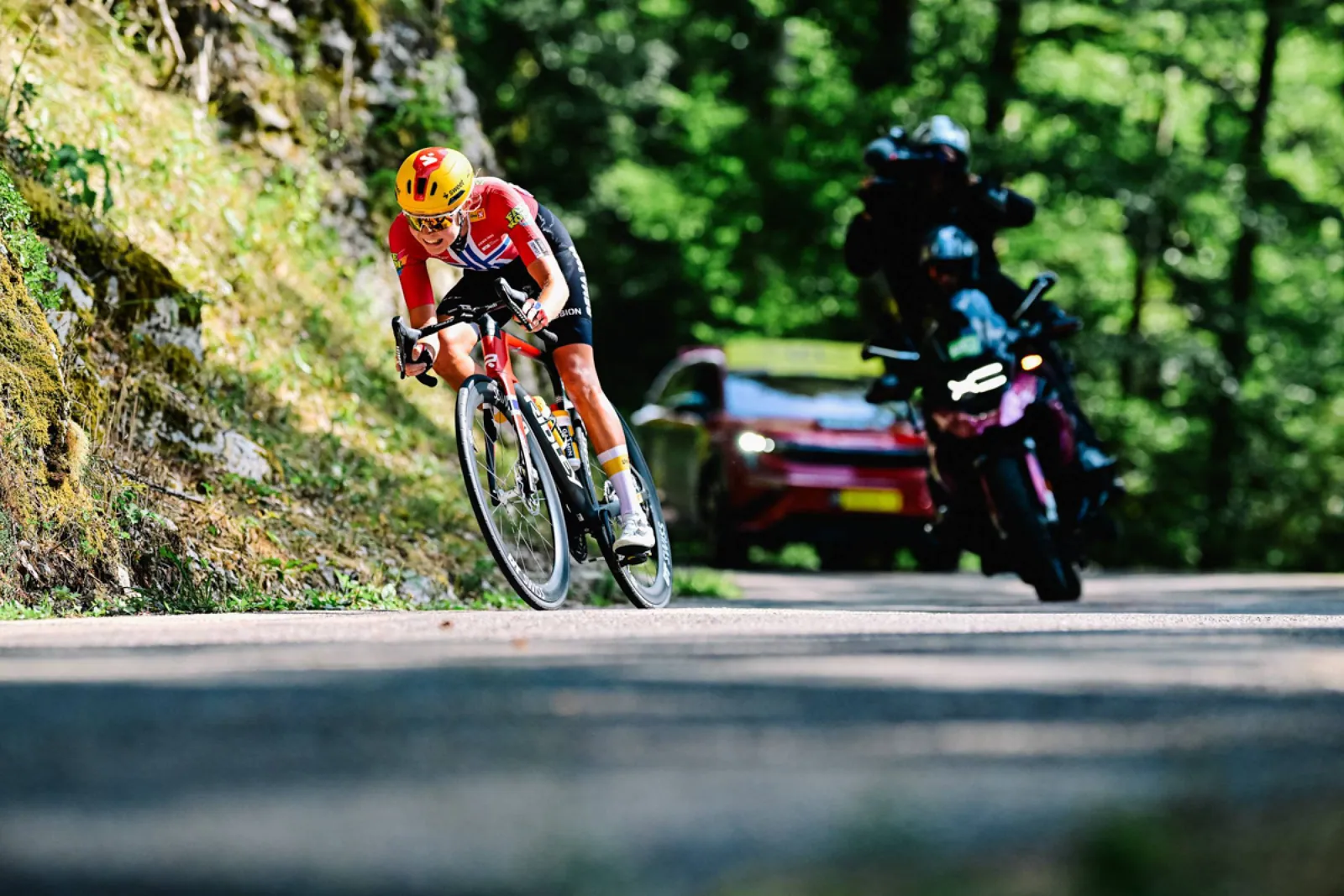
There are Tour de France victories that arrive with a train, a lead-out and a plan rehearsed all season. Then there are victories like Sigrid Ytterhus Haugset’s on the road to Poligny: one rider, one impossible distance and a decision to keep pedalling when even she thought the catch was inevitable.
Stage 3 of the 2026 Tour de France Femmes ran 156.5 km (97.2 mi) from Geneva across the French border and into the Jura. Its 2,500 m (8,202 ft) of climbing broke the rhythm of the opening sprint stages. Yellow jersey Lorena Wiebes was dropped on the Col de la Faucille. The race opened, and for a few hours it belonged to anybody brave enough to take it.
The move that was not supposed to last
Lucinda Brand started the first serious move after the Côte de Lajoux. Ten riders came together; Haugset bridged across to make eleven. When EF Education–Oatly pulled the group back at the foot of the Col de la Savine, the Norwegian champion did not return quietly to the bunch. She attacked. At the summit she had 35 seconds and 88.5 km (55.0 mi) still to race.
It looked like a move made to animate the stage, not win it. Haugset was 27, in her first season at WorldTour level and only 36 days removed from her first professional victory, the Norwegian road title. Ahead lay hours of exposed road. Behind was a peloton full of Tour winners, world champions and teams with more cards to play.
"I would say this is a dream come true, but I actually hadn’t even thought about it. I never thought this could be possible. Standing here is unreal."
The world champion in the mirror
Lotte Kopecky attacked in pursuit with 76 km (47.2 mi) remaining. For most riders, seeing a multiple world champion coming across would be the signal to wait, combine forces and accept that first place had changed shape. Haugset nearly agreed. She heard the gap was small. She wondered whether second behind Kopecky would already be enough. Her directors told her to keep going.
The numbers tightened cruelly. Haugset had led Kopecky by 1:20 at the intermediate sprint. The gap was 35 seconds over the Côte de Chaux-Champagny. With 10 km (6.2 mi) left, it was 15 seconds. The catch felt not merely possible but scheduled.
"I thought I might as well sit up and wait for her, because being second to her was already a good enough result for me. But I kept going."
And then the gap grew. Kopecky had spent too much on the chase; Haugset found one last reserve into the headwind. Fifteen seconds became daylight, then certainty. She reached Poligny 1:24 ahead of Kopecky. Marianne Vos won the sprint for third from the favourites’ group, 2:48 behind.
Yellow, with no energy left to celebrate
The finish supplied the image this stage deserved. Haugset raised one arm, barely. She had ridden so far beyond expectation that the usual choreography of victory — zip the jersey, sit up, smile for the cameras — was physically out of reach. She was dizzy. She later joked that her boyfriend would be annoyed by the missing celebration, but she could not lift her arms from the handlebars.
That is what made the day joyful. It was not joy manufactured after the result; it was joy built into the racing. A rider attacked because the road invited her. A champion chased because the race was escaping. The favourites attacked one another, hesitated, regrouped and lost their chance. There was no script sturdy enough to survive the Jura.
A result bigger than its place in the standings
Haugset took yellow with 2:02 over Kim Le Court-Pienaar and 2:06 over Demi Vollering. The next day’s 21 km (13.0 mi) time trial would bring a different kind of pressure, and the Tour’s final shape would still be decided in the mountains. None of that reduced what happened on Stage 3.
For 88.5 km (55.0 mi), the strongest teams could see the Norwegian champion and could not reach her. She expected Kopecky to catch her. Kopecky expected to catch her. Everyone watching could understand the arithmetic. Haugset kept going anyway. Sometimes pure racing is simply the moment a rider refuses to believe the obvious ending — and discovers that the road has made room for another one.
Race narrative, route and classifications: Tour de France Femmes — official Stage 3 report ↗
Winner’s reaction: Tour de France Femmes — Sigrid Haugset interview ↗
Stage route and profile: Tour de France Femmes — Stage 3 ↗
Results and chase detail: Cyclingnews — Stage 3 report ↗