Why the Yellow Jersey Matters More Than Ever
From 23.2 million live viewers at its return to a record-breaking French audience: how changing champions made the Tour the joyful centre of women's cycling.
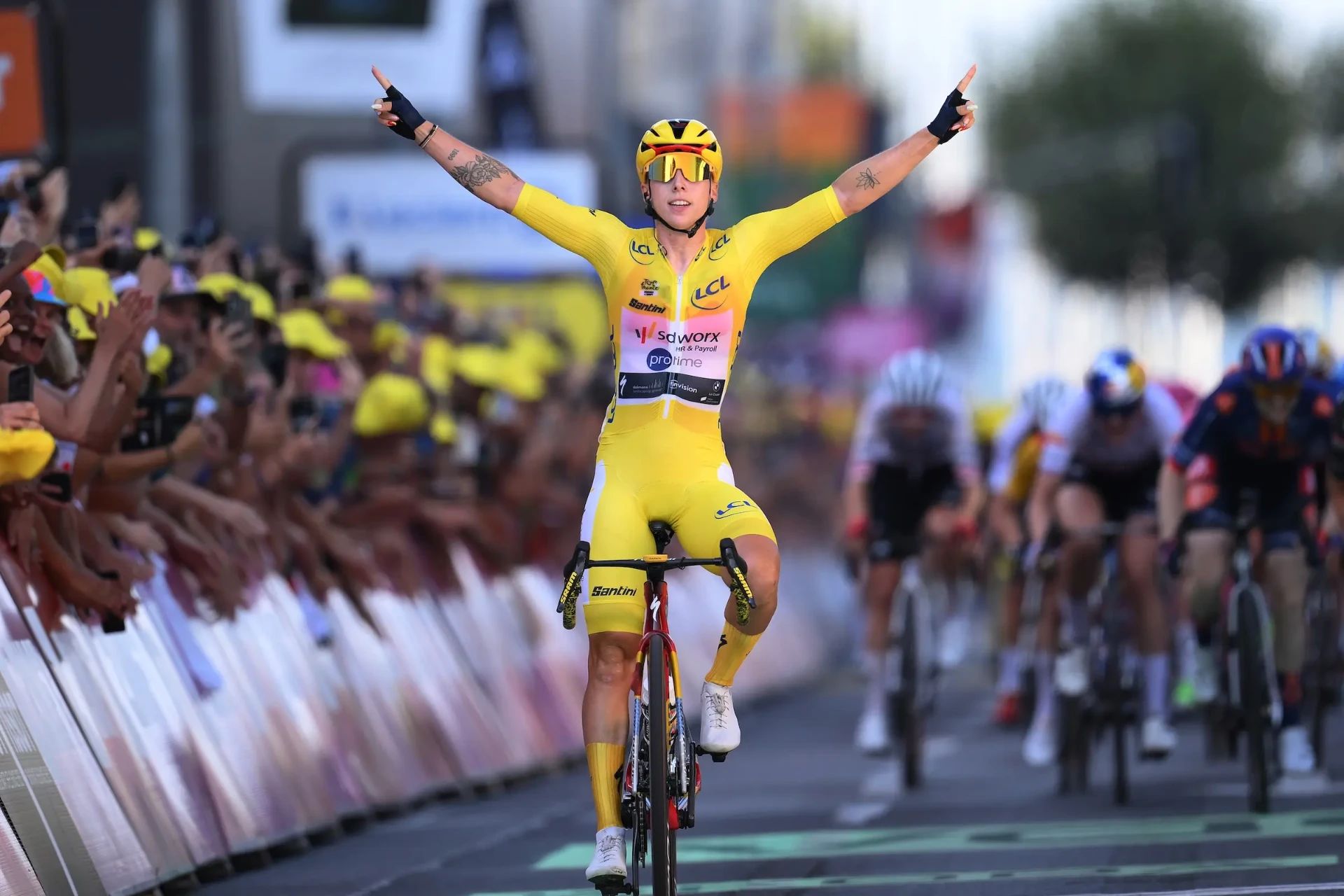
The yellow jersey matters because everybody already understands it. A child beside the road, a sponsor deciding where to invest, a viewer arriving halfway through a mountain stage: nobody needs the symbol explained. Yellow means the race has found its centre. It means this rider, today, is carrying the most visible prize in cycling.
For generations, women were asked to build a professional sport without regular access to that symbol. There were great champions, great stage races and earlier women's Tours, but no durable modern race with the Tour de France name, its daily live broadcast and its place in the wider public imagination. When the Tour de France Femmes returned in 2022, it did not make women's cycling legitimate. The racing had done that long before. It made that legitimacy impossible for the rest of the world to ignore.
A race the whole world can find
The foundation was visibility. Before the first stage had been raced, France Télévisions committed to live daily coverage and the European Broadcasting Union secured distribution across 54 additional European territories. The race would also be available on broadcasters' digital platforms. By 2024, the Tour said it was being shown in 190 territories. That reach changed a familiar frustration of women's cycling: fans no longer had to hunt for a stream, wait for highlights or follow the decisive move through social-media updates. The race was simply there, live, every afternoon.
The audience arrived immediately. Nielsen Sports data commissioned by Zwift put the inaugural 2022 edition at 23.2 million cumulative live viewers across eight key markets, with 2.9 million watching an average stage. In France alone, nearly 20 million people watched across the week. Those were not charitable clicks for a worthy cause. They were audiences choosing a bike race.
The mountains made appointment television
A broadcast agreement creates the possibility of an audience. Racing creates the habit. The modern Tour understood that its great climbs could do more than separate the general classification: they could give the women's race shared cultural moments of its own.
In 2023, 4.3 million viewers in France watched Demi Vollering ride through the Tourmalet mist and take yellow, a 34.6% audience share. Roughly two million people watched the average stage. The following year, Alpe d'Huez delivered a different kind of suspense. Vollering won the stage, but Kasia Niewiadoma survived the climb and kept yellow by four seconds — close enough that the virtual classification changed with nearly every time check.
2023 audience: Tour de France Femmes audience figures reported by Bicycling ↗
"I hated everything, to then arriving at the finish line and learning that I had won the Tour de France, which is insane!"
That is the Tour at its most powerful. The jersey turns arithmetic into emotion. A crash on an ordinary road matters three days later. A teammate's pull in a valley matters on the final mountain. Four seconds can contain a season of preparation, an entire team's future and the difference between being remembered as the winner and as the rider who almost was.
Four editions, four champions
The first four modern Tours refused to settle into a single story. Annemiek van Vleuten won in 2022 with overwhelming mountain strength after illness and mechanical trouble. Vollering took over in 2023 on the Tourmalet. Niewiadoma survived the four-second Alpe d'Huez thriller in 2024. Pauline Ferrand-Prévot returned to road racing and, in 2025, became the first French winner of the modern race.
2022 champion: BBC Sport — Van Vleuten wins the inaugural modern Tour ↗
2023 champion: Tour de France Femmes — Vollering takes yellow on the Tourmalet ↗
2025 champion: Tour de France Femmes — Ferrand-Prévot seals yellow in Châtel ↗
When a home victory became a national event
The 2025 edition showed what happens when sporting jeopardy, national recognition and easy access meet. France Télévisions reached 25.7 million people who watched at least one minute across the nine stages and its Vélo Club programme — 7.4 million more than in 2024. The average stage drew 2.7 million viewers and a 31.6% audience share. Ferrand-Prévot's final-stage victory averaged 4.4 million, then peaked at 7.7 million as she completed the first French overall win of the modern era.
The younger audience mattered too. France Télévisions reached 2.1 million people aged 15–24, nearly twice the previous year's figure. Its platforms recorded 3.8 million video views, four times the 2024 total. The Tour was no longer proving there was an audience for women's cycling. It was showing broadcasters that the audience could grow, move between television and phones, and gather around a woman in yellow as naturally as cycling audiences always have.
Attention changes what is possible
Visibility is not the same thing as equality, and the race has not erased the sport's gaps in pay, resources or calendar stability. But it has changed the negotiation. Sponsors can see millions of viewers. Teams can sell a story that reaches beyond specialist cycling media. Riders can become recognisable beyond the people who already knew their palmarès.
Reporting on the 'Tour effect' has traced rising team budgets, larger contracts and new sponsor interest back to the visibility created each July and August. The causal chain is not mysterious: live pictures create familiarity; familiarity creates stars; stars create reasons to return; returning audiences create commercial value. Every part of women's cycling benefits when its biggest race is impossible to overlook — even races that happen months away from France.
"There was a need for a benchmark race that spoke to everyone, and that meant the Tour de France."
Commercial impact: Cyclingnews — contracts, budgets and the Tour de France Femmes effect ↗
Why it is the pinnacle
The Tour is not automatically the hardest race on every route, nor does winning it make every other objective secondary. The Giro has its own history. The Classics demand skills a stage race cannot. The World Championships confer a jersey worn all year. But no other race combines the Tour's audience, symbolism, accumulated pressure and daily narrative.
To win yellow, a rider must keep surviving the sport as it changes shape: crosswinds, sprint trains, time trials, heat, crashes, descending, recovery, team politics and the final mountains. The leader is visible every day and vulnerable every day. Rivals do not have to beat her everywhere. They only have to find the one terrain, one hesitation or one bad afternoon that changes the colour on her shoulders.
That is why the jersey's movement matters. Van Vleuten's authority made Vollering's succession meaningful. Vollering's dominance made Niewiadoma's four seconds miraculous. Niewiadoma's victory made Ferrand-Prévot's home win feel like another expansion of who could own the race. In our 2026 race, yellow moved again — from Reusser, to Niewiadoma-Phinney on Mont Ventoux, and finally to Vollering in Nice. Every transfer asked viewers to revise what they thought they knew.
2026 race record: Cycling Femmes race desk — Tour de France Femmes 2026 ↗
The joy is the point
Growth is usually described in numbers because numbers win arguments: viewers, territories, broadcast hours, contracts. But the thing those figures are measuring is joy. It is the crowd learning the names. It is a young rider seeing a woman pull on yellow and understanding, without qualification, what the dream looks like. It is a family reorganising an afternoon around the final climb. It is the group chat doing time-gap mathematics with 5 km (3.1 mi) to go.
The Tour de France Femmes has given women's cycling a common appointment and then rewarded the audience with uncertainty. Its champions have not repeated one another's victories; they have contradicted them. Power, patience, survival and reinvention have all won. The jersey keeps changing hands, and every time it does, the sport feels larger.
That is why yellow matters more than ever. Not because women needed the Tour's permission to race brilliantly, but because brilliance deserves the biggest possible stage — and because, once millions of people have felt the suspense together, nobody can plausibly ask whether the audience is there.
Launch and purpose: Tour de France Femmes — 2021 launch announcement ↗