The Multidiscipline Generation Is Redrawing Road Racing
From Kristen Faulkner's double Olympic gold to Puck Pieterse's bike changes, the best road racers increasingly refuse to stay in one lane.
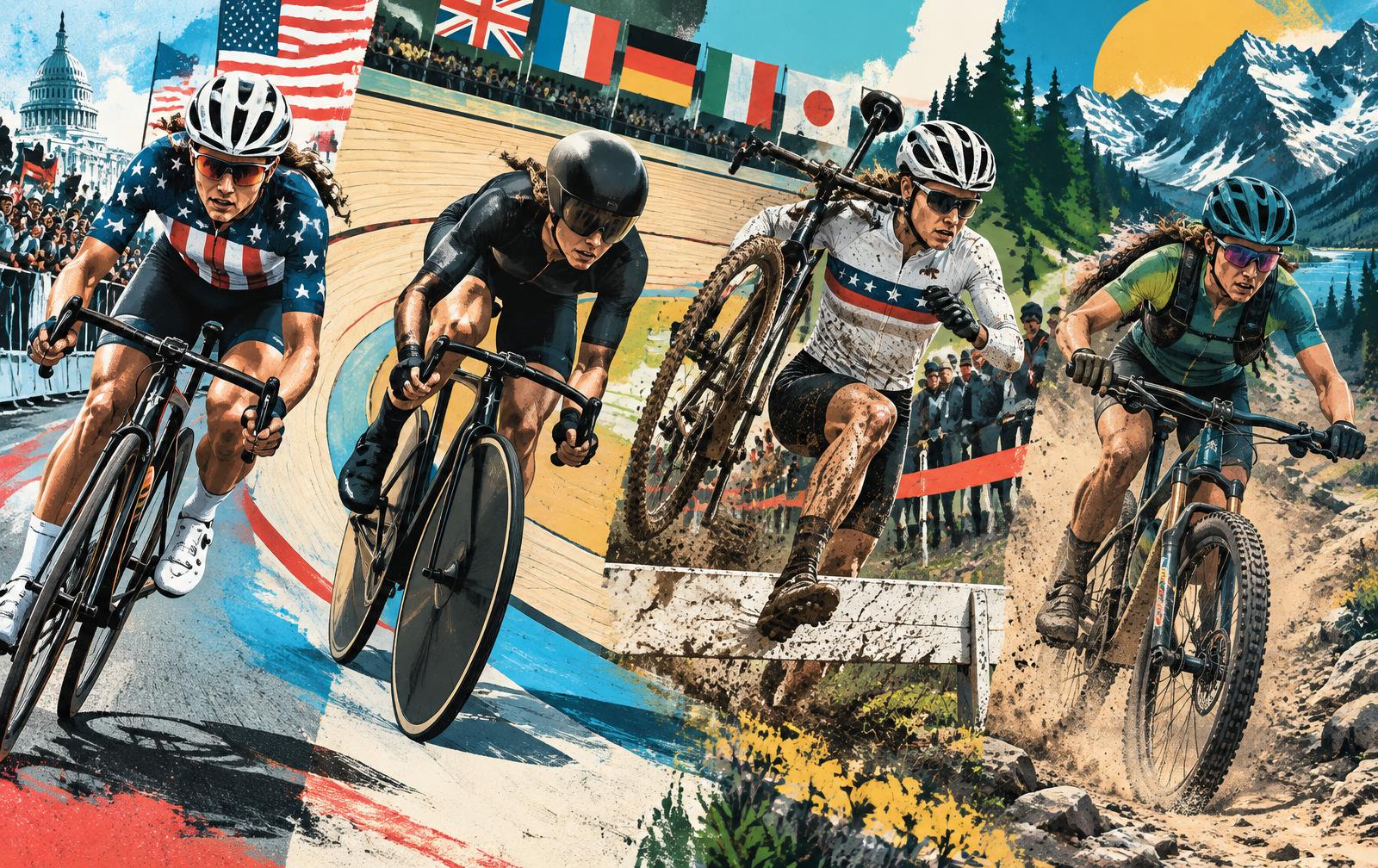
The old development model asked a rider to choose. Road or track. Cyclocross or mountain bike. Gravel as a detour, not a destination. The most exciting women of this generation keep refusing. They cross disciplines inside a season and bring the skills back with them: track timing to a sprint, cyclocross handling to a wet descent, mountain-bike line choice to gravel and road-race patience to everything.
America's double-gold proof
Kristen Faulkner arrived at the Paris Olympics as a road racer who had learned team pursuit late enough that her place was not inevitable. She left with gold in both. First she attacked away to win the 158 km (98.2 mi) road race. Three days later she joined Chloé Dygert, Jennifer Valente and Lily Williams to win the United States' first Olympic women's team-pursuit title.
The crossover suited her history. Faulkner came from rowing, began bike racing in 2017 and describes herself as primarily a road rider who also explores track, gravel and esports. Team pursuit sharpened repeated high-power efforts and absolute commitment to a line; road racing gave her the endurance and tactical nerve to make the Olympic attack.
Kristen Faulkner's multidisciplinary profile: Team USA ↗
The American pursuit pipeline
Chloé Dygert represents a longer track-road braid. Her individual-pursuit speed made her a world-class time trialist, while road racing demanded handling, positioning and resilience beyond a controlled four kilometres. In 2025 she finished ninth in the elite road Worlds time trial, then won individual-pursuit bronze at the track World Championships.
Dygert's 2025 individual-pursuit world bronze: USA Cycling ↗
The U.S. pathway is widening beyond the velodrome. Gravel gives young riders a commercially viable arena with long races, technical surfaces and less dependence on the traditional European team ladder. In 2026, 20-year-old Kylee Hanel moved from a road podium at Tour de Bloom to winning the Unbound Gravel 100 in the same season — a direct example of skills and opportunity moving both ways.
Kylee Hanel's road-to-Unbound crossover: Cyclingnews ↗
Puck changes bikes without changing herself
Puck Pieterse is the clearest European expression of the new model. She wins cyclocross World Cups, became cross-country mountain-bike world champion, won a Tour de France Femmes stage and then conquered La Flèche Wallonne. Her 2026 plan deliberately moved through cyclocross, the road Classics, mountain bike, the Tour and mountain-bike Worlds.
Pieterse on making multidiscipline excellence sustainable: Escape Collective ↗
Cyclocross teaches starts, accelerations and the calm required when traction disappears. Mountain bike rewards line choice and repeated surges. Those skills do not guarantee a road win, but they reduce the number of moments in which a race can surprise her. The bike changes; the visual processing does not.
The champion who made it imaginable
Pauline Ferrand-Prévot provided the template. She has held world titles on the road, in cyclocross, mountain bike and gravel, including an unprecedented simultaneous set of cross-country mountain-bike crowns. Returning to full-time road racing, she won the 2025 Tour de France Femmes. Her career makes specialization look like one route, not the rule.
Ferrand-Prévot's cross-discipline world titles: UCI ↗
Not a novelty — a competitive system
Multidiscipline racing has costs: conflicting calendars, equipment changes, travel and the risk of never fully recovering. It works only when teams and federations stop treating another discipline as disloyalty. The reward is a rider with more ways to solve a race and, often, more ways to remain excited by the sport.
This generation is not proving that every road rider should race everything. It is proving that the boundary was artificial. Faulkner's two gold medals, Dygert's pursuit engine, Pieterse's handling and Ferrand-Prévot's reinvention all say the same thing: a discipline can be a specialty without becoming a cage.