Lotte Kopecky Was Built for Every Race
Track arithmetic, cobbled force and championship patience: how cycling's most versatile racer carries one discipline's intelligence into the next.
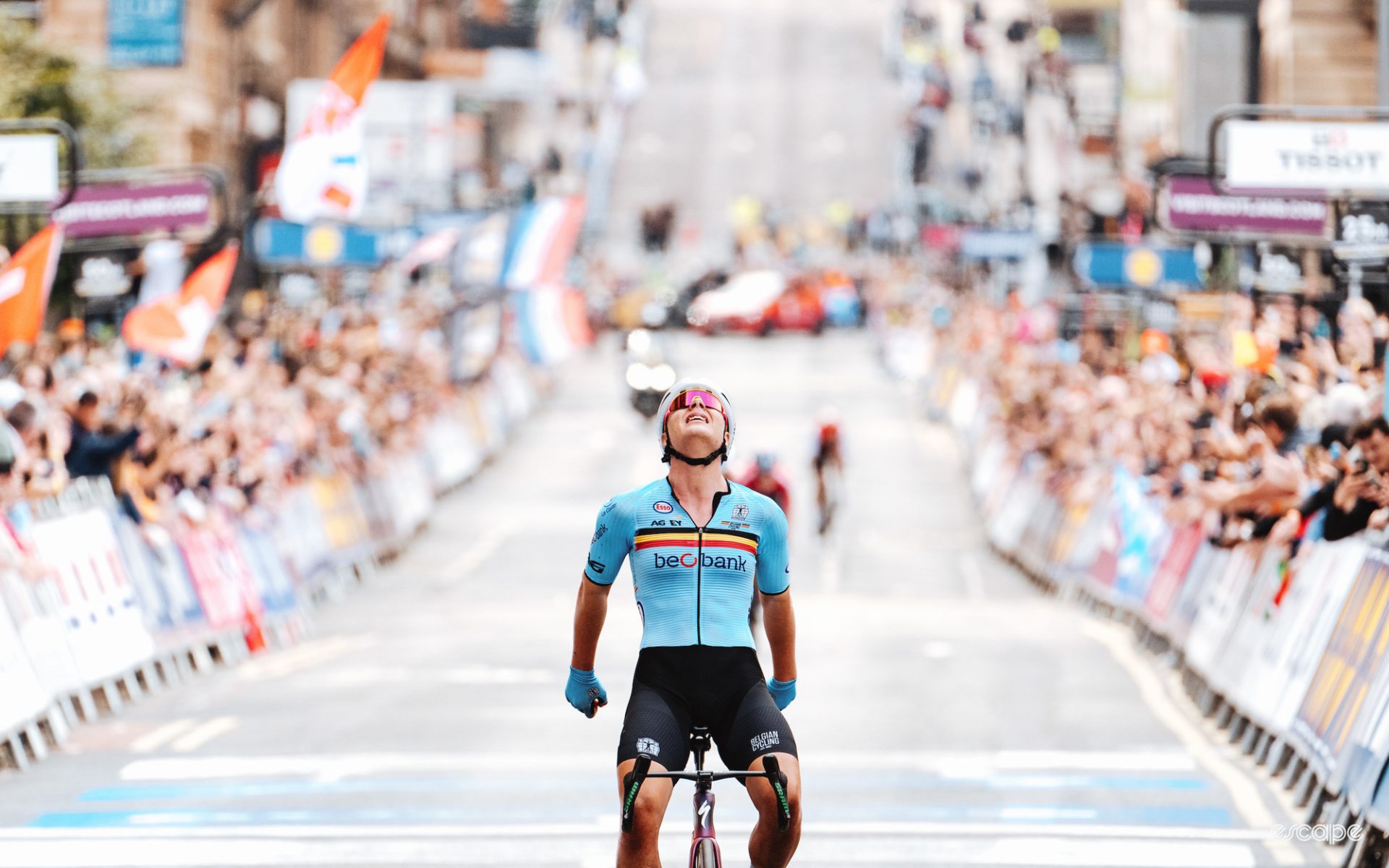
Most champions spend a career narrowing the kind of race they can win. Lotte Kopecky kept widening hers. A wooden velodrome taught her to read speed in centimetres. Flemish cobbles rewarded force and nerve. World Championship courses in Glasgow and Zürich asked her to survive climbs, absorb attacks and still sprint. Her defining skill is not power alone. It is carrying one discipline's intelligence into another.
The track inside the road racer
Kopecky is not a road rider who occasionally visits a velodrome. She is a multiple world champion in the Madison, points race, elimination and omnium. Those events demand constant arithmetic: laps gained, points available, rivals moving, partners arriving and effort spent. A road finale looks less chaotic when a rider has learned to make decisions at track speed.
Watch Kopecky in a reduced group. She does not need to dominate every move. She protects position, lets rivals expose themselves, then commits. Her 2024 world-title defence in Zürich was the model: she survived a course that invited climbers to eliminate her, followed the decisive changes and kept enough speed to finish the job.
How Kopecky defended the road world title in Zürich: Cycling Weekly ↗
A cobbled champion with range
Three Tours of Flanders, Paris–Roubaix Femmes, two Strade Bianche victories and Omloop Het Nieuwsblad place her among the era's defining Classics riders. Yet she has also won stage-race general classifications, points jerseys and Grand Tour stages. The same athlete can force a split on a cobbled climb, survive a hilly championship and deliver a bunch sprint.
"It was the race I wanted to win the most."
Roubaix mattered because it condensed her identity. The race rewards timing and resilience as much as raw strength, and it makes teamwork brutally visible. Kopecky called the 2024 victory her most special and the first Roubaix win for SD Worx–Protime. Even the most versatile rider in the field needed the race around her to be coherent.
Why versatility is not invulnerability
Range creates expectation. Kopecky can start so many races as a plausible winner that every defeat can look like a missed opportunity. Her difficult 2025 Tour de France Femmes, complicated by a back injury, was a reminder that an all-rounder still has a body with limits. Returning to the track later that season restored competition in a form that felt immediate and familiar.
Kopecky's track return after a difficult road summer: Cyclingnews ↗
The calm and the loco
Profiles of Kopecky often describe the contrast between the controlled racer and the playful person away from competition. She has called herself a little “loco”; on the bike, the apparent spontaneity is supported by years of pattern recognition. The attack can look impulsive because the calculation happened before the camera noticed.
Kopecky on the personality behind the racer: Cycling Weekly ↗
That is why Kopecky fits almost every race without becoming the same rider in all of them. On the track she counts. On cobbles she imposes. In a championship she waits. The disciplines do not compete for her identity; they complete it. Her career is an argument that specialization can make a champion, but fluency can make a rider impossible to categorize — and therefore almost impossible to race.