Fuel for Nine Days: What a Women's Grand Tour Takes
There is no third week and no rest day at the Tour de France Femmes. The nutrition challenge is a compressed sequence of racing, recovery and health decisions.
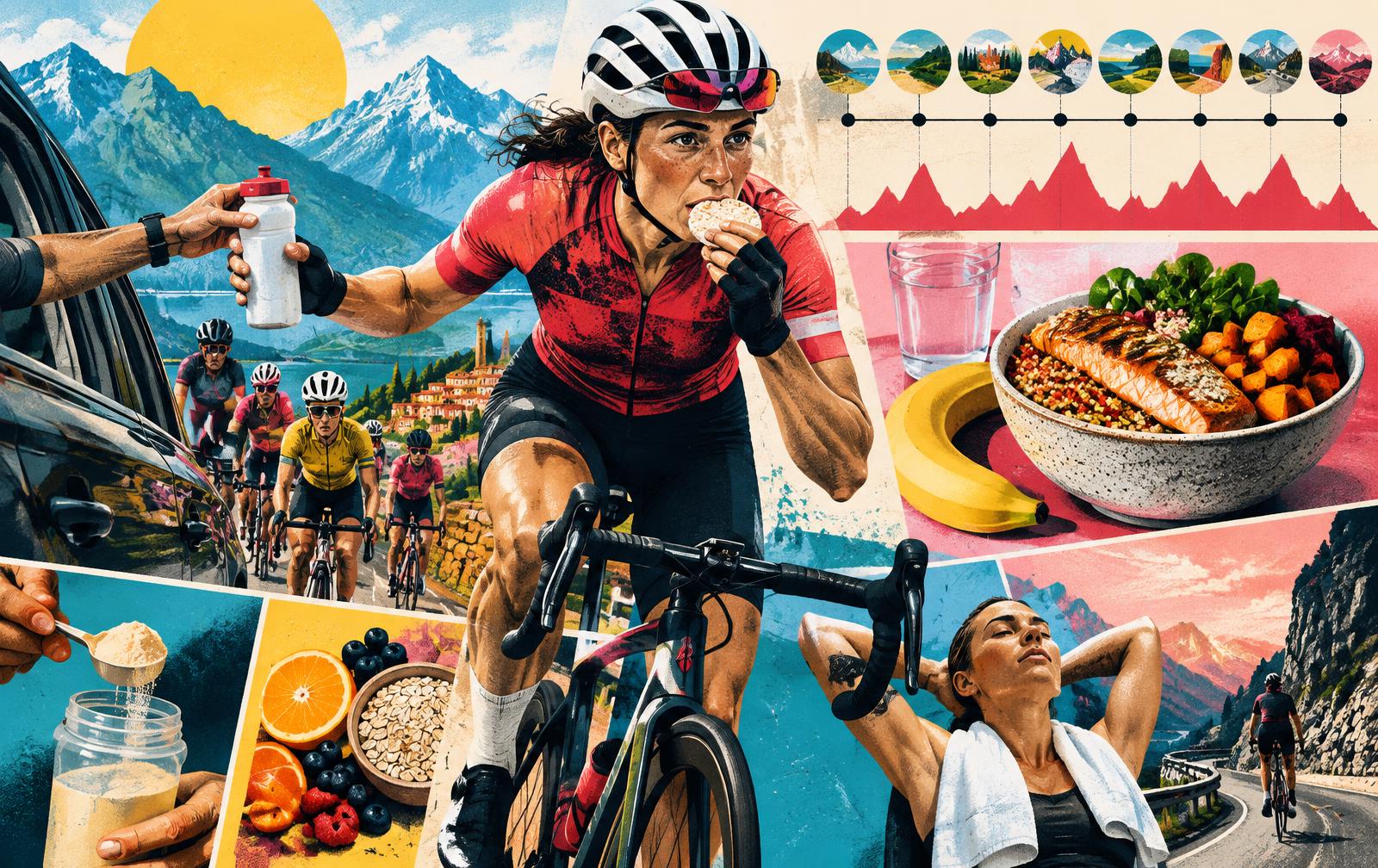
There is no third week in a women's Grand Tour. The 2026 Tour de France Femmes runs for nine stages without a rest day: 1,174.7 km (730.0 mi) of racing compressed into nine consecutive days. The Giro and Vuelta are shorter than their men's equivalents too. That changes the question. The challenge is not surviving day seventeen. It is arriving at day nine without letting a relentless sequence of deficits become the race.
Shorter does not mean simple
A nine-day race produces less accumulated load than three weeks, but it also removes the reset of a rest day. Riders have to eat for today's work while replacing yesterday's losses and preparing for tomorrow. A cold stage, a crash, stomach trouble or one missed recovery meal can follow a rider to the finish because the calendar never pauses.
The sport sometimes discusses a longer women's Tour as if duration alone proves equality. Race director Marion Rousse has argued for measured growth; riders including Pauline Ferrand-Prévot have said a three-week race should not be the automatic destination. Before asking women to race for 21 days, cycling still needs to understand what the current race demands from them.
The debate over whether the women's Tour needs three weeks: Cyclingnews ↗
One rider is not a peloton
In 2024, researchers published the first doubly labelled water study of a female WorldTour rider during the Tour de France Femmes, using the 2023 eight-day race. It was valuable precisely because the evidence base was so thin. It was also one case study. The finding cannot be turned into a universal menu for riders with different bodies, roles, training histories and menstrual status.
Energetics of a WorldTour female road cyclist during a multistage race: International Journal of Sport Nutrition and Exercise Metabolism ↗
That research gap shapes what teams can responsibly claim. General sports-nutrition guidance provides ranges for carbohydrate, protein, hydration and energy availability, but an athlete's plan has to respond to her work and health. A climber protecting general classification does not have the same stage as a lead-out rider collecting bottles and repeatedly moving through the peloton.
Recovery starts before the finish
Fueling is not an evening task. It begins at breakfast, continues on the bike and accelerates as soon as the rider finishes. Teams use bottles, gels and real food during racing because appetite and gut tolerance can become limiting long before the legs do. Afterward, carbohydrate replacement, protein, fluids, cooling, sleep and the simple ability to calm down all become part of tomorrow's performance.
Sleep data from professional riders in the men's 2022 Tour and women's 2022 Tour de France Femmes showed why recovery cannot be reduced to hours in bed. Stage type, timing, travel and individual response all matter; heart-rate variability and sleep efficiency add context, not a single readiness score that applies to everybody.
Sleep and recovery across the men's and women's Tours: Sports Medicine – Open ↗
The danger of eating less to climb faster
Cycling's oldest performance myth is that lighter is always faster. Low energy availability can initially look like discipline while undermining reproductive function, bone health, immunity, gastrointestinal health, mental health and performance. The IOC groups those consequences under Relative Energy Deficiency in Sport, or RED-S.
2023 IOC consensus statement on RED-S: British Journal of Sports Medicine ↗
Female-athlete research also warns against turning menstrual-cycle phases into simplistic rules. Hormones can affect substrate use, hydration and recovery, but cycles and symptoms vary widely. Tracking can support an individual athlete; it should not become another way to declare what every woman ought to feel on a given day.
Recommendations and nutritional considerations for female athletes: Sports Medicine ↗
Fuel the race that exists
Women's cycling does not need to borrow the mythology of the men's third week to make its Grand Tours hard. Nine uninterrupted days are their own physiological and logistical problem. The best nutrition work is therefore unglamorous and individual: enough energy, delivered often, adjusted honestly, with health treated as part of performance rather than its price.