Beyond the Bike: The Women Who Built Two Careers
Doctors, a mathematician, a lawyer, investors, a teacher and a florist: the extraordinary lives inside the professional peloton — and the history that made two careers necessary.
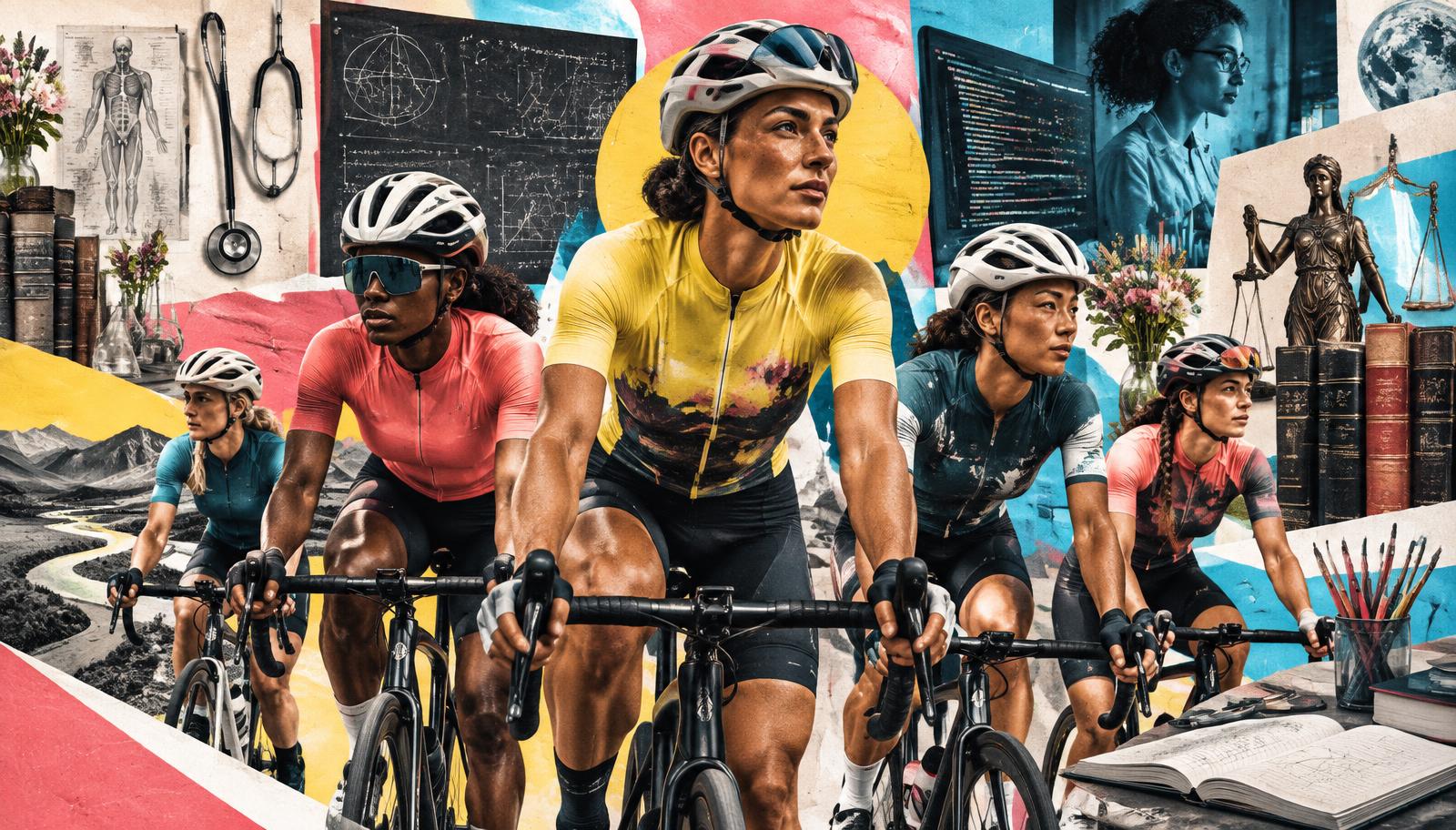
Marlen Reusser worked in a Swiss hospital before she became the rider every time triallist measures herself against. Elise Chabbey finished medical school, raced at the highest level and returned to 12-hour hospital shifts during the first wave of COVID-19. Anna Kiesenhofer completed a doctorate in mathematics, conducted research at EPFL and then designed the ride that made her Olympic champion.
These are not cute facts to place beneath a palmarès. They are lives of unusual range. Across the women's peloton are doctors, scientists, lawyers, teachers, investors, entrepreneurs and skilled tradespeople. Their work beyond cycling deserves admiration on its own terms — and it also reveals something uncomfortable about the sport that asked so many of them to build two futures at once.
Two careers were often survival, not branding
The first UCI minimum salary for salaried Women's WorldTeam riders arrived only in 2020. It began at €15,000, rose to €20,000 in 2021 and came with protections such as health insurance, maternity leave and paid holidays. That was progress, but it applied to the top division, not every woman racing internationally. For generations, study and paid work were not evidence that riders had spare time. They were insurance against a short career in a sport that did not reliably pay a living wage.
That history changes the way these stories should be told. The point is not that elite athletes are surprisingly capable away from a bicycle. It is that women reached the top of a global sport while carrying degrees, shifts, exams, businesses and uncertain contracts — and that many refused to let cycling become the only measure of who they were.
The doctors in the peloton
Marlen Reusser lists her trained profession plainly: physician, Dr. med. She completed medical studies in 2017, the same year she obtained a racing licence and won the Swiss time trial championship. She then worked in a hospital in Langnau and reduced her hours as racing expanded, before committing fully to cycling in 2019. Her ambition is not to trade one identity for another forever; she has spoken about returning to medicine after racing, while acknowledging that doing so will require renewed training.
Medical qualification and current profession: Marlen Reusser — official site ↗
From hospital work to professional cycling: Velo / Outside ↗
Elise Chabbey's route was different and, in 2020, more immediate. The former Olympic canoeist completed her medical degree in October 2019. When racing stopped during the pandemic, she went to Geneva University Hospitals and worked 12-hour shifts for three months. She was not borrowing a title for a biography: she was treating patients. Later that year she became Swiss road champion; since then she has become a world mixed-relay champion, Tour de France Femmes mountains winner and one of the peloton's most aggressive racers.
"I learned a lot and it was good for me to feel useful during this period."
Doctor, Olympian and WorldTour rider: UCI ↗
Medicine does not make either rider's victories more valuable. It does show the scale of their discipline — and the precision needed to move between institutions that each demand everything.
The mathematician who solved the Olympic race
Anna Kiesenhofer describes her life as parallel tracks in mathematics and cycling. She completed her doctorate in 2016, the same year she won her first UCI race, and later worked as a mathematical researcher at EPFL in Lausanne. She trained largely outside the conventional professional system, applying the same appetite for independent inquiry to performance, nutrition and equipment.
At the Tokyo Olympics, Kiesenhofer attacked almost immediately, committed to the break and rode alone to gold while the favourites behind misread the race. It is tempting to reduce the victory to a mathematician outsmarting the bunch. The more honest version is harder: she identified a possible route to victory, prepared herself to execute it, and then absorbed the physical cost when probability became opportunity.
"Many, many years of endurance training alongside my academic career."
Computer science, venture capital and calculated risk
Kristen Faulkner studied computer science at Harvard and rowed for the university before working in venture capital in New York and California. She began bike racing only after joining a women's clinic in Central Park. Her team describes the attraction precisely: cycling demanded strategy, patience and anticipation — a moving game of chess.
In Paris in 2024, she read the Olympic road race the way she had once assessed an investment: the obvious outcome was not the only one. She bridged to the leaders, recognised that the favourites might wait for one another and attacked. That decision produced road gold; three days later she won again with the U.S. team pursuit squad. Her earlier profession did not predict those medals, but it gave her a language for risk — what could fail, what could change everything, and when hesitation was more dangerous than action.
From Harvard and venture capital to double Olympic gold: EF Pro Cycling ↗
A lawyer learning a new rulebook
Clara Emond completed her legal studies, passed the Quebec bar and worked toward a master's thesis on athletes' rights before her cycling career accelerated. She did not grow up inside road racing's unwritten codes. When EF signed her, the team introduced a bar-accredited lawyer who had discovered road racing only a few years earlier. In 2024 she won a Giro d'Italia Women stage from a long breakaway — an accomplished qualification and an accomplished ride, neither needing the other as decoration.
Clara Emond's law and cycling path: EF Pro Cycling ↗
The careers before — and after — the finish line
Evelyn Stevens left finance for professional cycling after discovering the sport in her twenties. She became a world champion and Olympian, broke the Hour Record and helped define the aggressive racing of the 2010s. Retirement did not mean beginning again from zero: she returned to finance and is now a managing director at KKR. The athlete and the executive are not separate characters. Both careers ask for judgment under pressure, appetite for preparation and the ability to keep making decisions when the consequences are real.
Evelyn Stevens — finance, professional cycling and KKR: KKR ↗
Amber Neben made a similarly consequential choice. She was two years into doctoral work in physiology and biophysics at the University of California, Irvine when she left with a master's degree to pursue cycling. The distinction matters: she did not complete a PhD, and her scientific work should not be inflated to make the story cleaner. What she did become was a two-time world time trial champion and three-time Olympian — after surviving cancer in her twenties and building one of the longest elite careers in American racing.
Amber Neben's choice between doctoral research and cycling: UC Irvine ↗
Teachers, founders and florists count too
Academic titles are not the only form of accomplishment. Lauren Stephens studied mathematics and taught it at high school before becoming a professional racer, then helped build and captain a team of her own. Kate Courtney balanced elite mountain-bike racing with a human biology degree at Stanford and later founded the She Sends Foundation to widen girls' access to the sport. Their work turns expertise outward: one taught a classroom; the other is building a pathway.
From teaching high-school mathematics to professional racing: USA Cycling ↗
Creating access for girls in mountain biking: She Sends Foundation ↗
Demi Vollering trained and worked as a florist before becoming a Tour de France Femmes winner and world champion. The flower shops and family greenhouse are sometimes treated as charming colour around a superstar. They are more than that. They represent vocational skill, early shifts, customer work and the discipline of keeping living things alive. The sport is poorer when it treats accomplishment as synonymous only with a university credential.
Demi Vollering's work and training as a florist: KNWU ↗
More than a second act
Women's cycling is becoming more professional. That should mean a young rider no longer needs a second job simply to remain in the first one. It should mean education can be pursued because she wants it, not because an injury or a vanished sponsor could leave her with nothing. It should mean motherhood, study, work and racing are supported as parts of a life rather than framed as evidence of insufficient commitment.
But professionalisation should not flatten the peloton into athletes who know only sport. Reusser's medicine, Chabbey's hospital service, Kiesenhofer's mathematics, Faulkner's investing, Emond's law, Stevens' finance, Neben's science, Stephens' teaching, Courtney's foundation and Vollering's flowers make cycling larger. They bring other ways of seeing pressure, risk, care, systems and work into the bunch.
They are extraordinary bike racers. They are also people whose ambitions never fit inside the barriers. The remarkable part is not that they could do both. It is how long women's cycling expected them to — and how much they accomplished anyway.